Montag, 16. Juli 2018

Ein neuer Tag bricht an

Wieder im Feld

Nach einem erholsamen Wochenende im Wellness oder trotzdem auf dem Berg, startete das Team die Fortsetzung auf der Alp Natons. Gleichzeitig wurde auf und neben Spliatsch weiter prospektiert. Beides lässt sich mit einem Wort zusammenfassen: Schlackenhalde. 

Letzte Woche wurde viel vermessen, gezeichnet und wieder verfüllt. Unsere Neuen im Team haben viel gelernt und sind gespannt auf weitere Eindrücke und Funde!

Es folgen einige zusammenfassende Bilder der letzten Tage...bis bald!


Auf der Alp Natons

Kalkbrennofen I, Gruba


Kalkbrennofen II, Gruba

Die Biodiversität der Alp Natons

Schlacke, Alp Natons


Das Prospektionsteam bei der Arbeit


Sonntag, 15. Juli 2018

Wir im Wochenende

Wir entspannen  (Foto: David Pedrett).

Heute machen wir nach einer ereingisreichen Woche Pause!
Am Morgen sind wir wieder für euch im Feld!

Mittwoch, 11. Juli 2018

Weitere Entdeckungen kommen zutage

Holzkohle, Lehmschicht und seltene Schmetterlinge


Idyllischer Morgen bei Pinge 6
Bei Pinge 6 wurde Schicht um Schicht abgetragen, wobei mehrere Annäherungsversuche unternommen wurden. Mit viel Geduld kam eine rote, verbrannte Lehmschicht zum Vorschein, direkt darunter unverbrannter Lehm, gefolgt von einer Schicht aus Holzkohlebrettern (inkl. Maserung). Was das wohl sein könnte?

Simon am Tachymeter
Gleichzeitig wurde viel vermessen und eingelesen. 

Das Prospektionsteam war heute im Gebiet Spliatsch zwischen Sur und Scalotta (Marmorera) unterwegs. Hier wurden Schlackestücke am Hang gefunden, was nun weiter untersucht wurde. Mit Bohrer und Kellen bewaffnet wurden 6 Schlackenansammlungen verzeichnet. In 4 von 20 Bohrungen befand sich Holzkohle sowie eine fortlaufende Schichtung, welche sehr vielversprechend aussieht und definitiv weiter untersucht werden wird. 

Ausserdem finden diverse Natur- und Biointeressierte eine breite Vielfalt an Flora (zBsp. Felsen-Leimkraut, Silene rupestris) und Fauna (zBsp. Hirsche, Gämsen und verschiedenste Schmetterlingsarten).

Der gefährdete und seltene Apollofalter (Parnassius apollo)

Dienstag, 10. Juli 2018

Neu im Team OHS

Herzlich Willkommen!


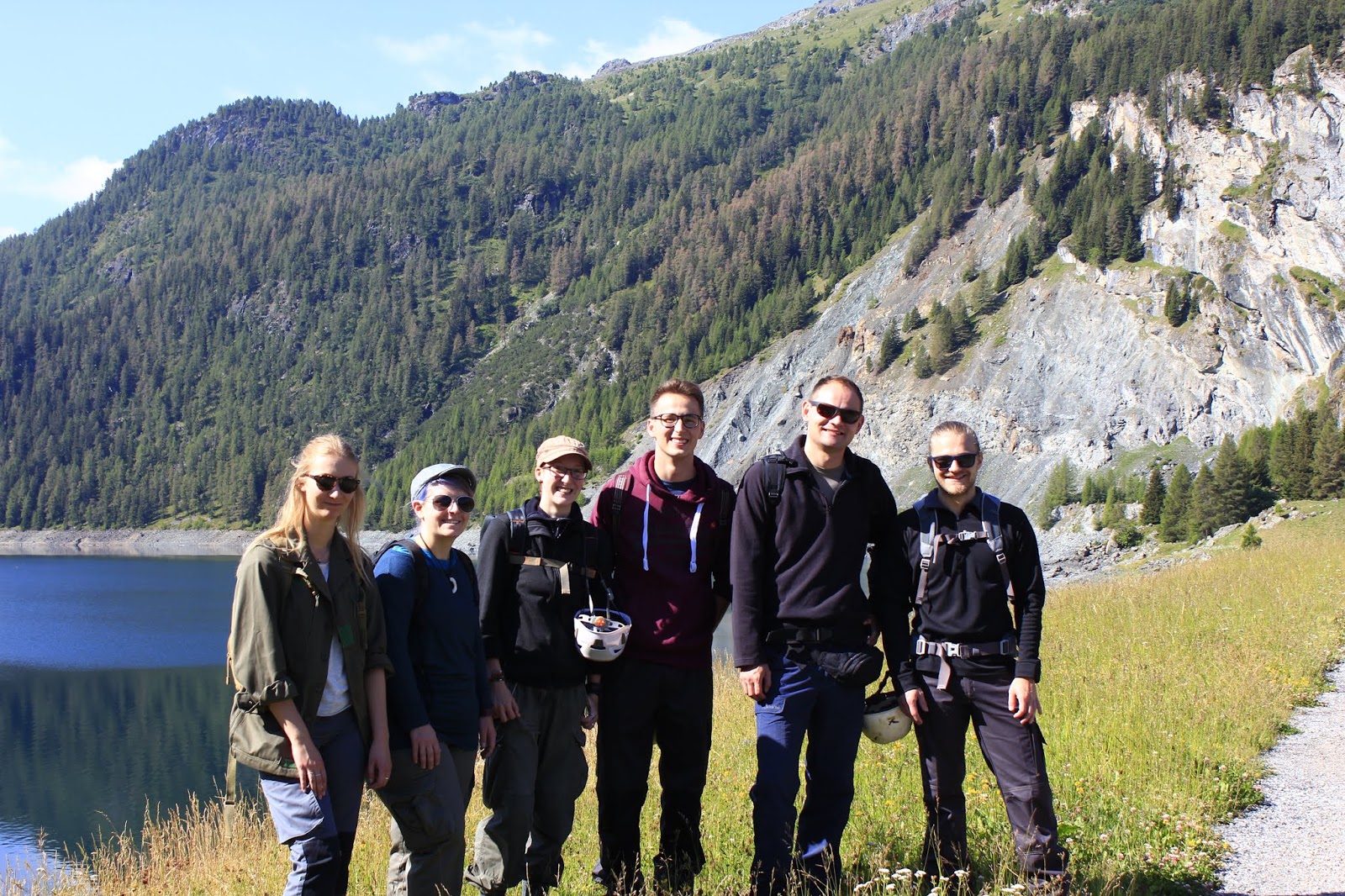
Die neuen Teammitglieder der 2018er Kampagne.

Von links nach rechts: Juliette Brangé, Michaela Genkinger, Antoinette Goujon, Timo Geitlinger, Rouven Turck (schon länger dabei ...) und Jonas Blum.

Montag, 9. Juli 2018

Jetzt geht's bergauf! Die ersten Tage im Feld

Das neue Team entdeckt Oberhalbstein

Frisch und motiviert startet das 11-köpfige Team die 6. Grabung im Oberhalbstein. Am Sonntag gab es ein entspanntes Sightseeing der wichtigsten Plätze, wie  der Stollen bei Marmorera, das Val Faller sowie die Fundstelle 12 am Marmorerasee.
Montagmorgens gab es eine Besichtigung der Pinge 6 auf Gruba, sowie eine kleine Führung durch den Wald, wo wir dem Erz folgten und schliesslich den Verhüttungsplatz erreichten. Nach vielen interessanten Eindrücken und einige Schlackestücke später machten wir uns wieder auf nach Bivio.

Betrachten des Schachtofens auf Gruba

Gruba erstiegen wir am Montag zweimal; Das benötigte Werkzeug kam erst am Nachmittag bei uns an. Allerdings liessen wir es uns nicht nehmen, bereits die Pinge 6 teils auszuheben und so für unsere weiteren Untersuchungen freizulegen. Dazu haben wir ein weiteres kleines Stück abgesteckt, welches wir diese Woche abtragen werden.
 
Ausheben der Pinge 6

Gleichzeitig war unser Prospektionsteam erfolgreich und brachte Kupfererzproben mit Sekundärmineralien aus dem Val Faller (Gebiet Muttans) mit.
Ausserdem wurde die Fundstelle 12 von Gestrüpp und störenden Objekten befreit. Beim Kratzen mit der Machete kam Erhofftes zutage: Holzkohle!
 
Wir sind also gespannt auf weitere Entdeckungen!

Mittwoch, 4. Juli 2018

SISA theory, part 1: July 23rd

SISA 1, 2018


23.07.2018: Theory 1, Hotel Piz Platta, 8:30-13:15 /18:30


Session 1, Part 1, Rouven Turck, UZH, FB PRA
8:30 – 9:00

Welcome to SISA 2018 – Introduction to prehistoric mining in the Oberhalbstein (GR)

Main goals and topics of the SISA 2018 contents are introduced to the audience.
The first paper deals with current archaeological research in the Oberhalbstein valley. Local features of prehistoric mining and smelting will be presented: Mining galleries, collapsed shafts, roasting beds and smelting furnaces that have been archaeologically documented since 2013.
A brief comparative overview of findings and features from Eastern Alpine mining and smelting activities completes this introduction.


Session 1, Part 2, Philippe Della Casa, UZH, FB PRA
9:00 – 9:45

Survey Methods

Alpine landscapes, and mining landscapes in mountain regions in particular, require specific and adapted methods of archaeological survey and investigation. In the Oberhalbstein valley, documental and both non-invasive and invasive prospection techniques have successfully been applied: Archival data mining, traditional ground survey by terrain walking, geophysical survey (geomagnetics, electrical resistivity tomography), sediment coring with augers, and small test pits. Together with excavations in selected sites, a wealth of complementary data could be gained in order to address spatial, chronological and technical questions on mining activities.


Session 1, Part 3, Donat Fulda SGTK/ETHZ
10:00 – 10:30

Geology 1: Geology of the Oberhalbstein valley

Why are important copper resources located in the Oberhalbstein valley? What kind of rocks do we find there? What do they tell us about their formation and origin?
We will briefly introduce the geology of the Alps and the regional geological setting during our morning lecture. Later on, with our afternoon field trip, we will focus on the geology of the Oberhalbstein area with its tectonic history, the necessary conditions for ore formation and the occurring wide variety of rock units. During that walk, we will come across marine sediments, volcanic and metamorphic rocks as well as rocks originating from the earth’s mantle that are partially enriched with copper-bearing minerals.


Session 1, Part 4, Gert Goldenberg, UIB
10:30 – 11:15

Geology 2: The use of geo-resources in alpine prehistory with special consideration of copper ore deposits, copper mining and metallurgy


- Text -


Session 1, Part 5, Leandra Reitmaier-Naef, UZH, FB PRA
11:30-12:30

Copper smelting slag from the Oberhalbstein - typology, mineralogy and geochemistry

Mining archaeologists and archaeometallurgists have attempted to decipher the prehistoric multistage process of copper smelting from chalcopyrite for a number of decades. For this purpose, various examinations of archaeological remains, historical and ethnographical comparisons, and archaeological experiments have been carried out. Apart from archaeological structures such as furnaces, very little if any of the original raw materials (copper ore) or final products (matte/raw copper) remain from which the process could be reconstructed. Only smelting slag is usually available in vast quantities. By conducting typological, geochemical and mineralogical analyses of this by-product, information can be gained concerning the reactor, process steps, raw material, charge composition, process temperature, furnace atmosphere and even the resulting (intermediate) product, as will be shown by the example of recently examined smelting slag from the Oberhalbstein.


Session 1, Part 6, Donat Fulda SGTK/ETHZ
13:15 – later afternoon

Geology 3: Landscape viewing in the field.


Montag, 2. Juli 2018

Cotschens im BERGNKNAPPEN

Vorbericht des FBG im Bergknappen


Ein Hinweis: Der Vorbericht der Freunde des Bergbau Graubünden ist im aktuellen BERKNAPPEN, 132, 1/2018 erschienen! 

Viel Spass beim Lesen und Glück auf!!